Welcome back:) Evidently, I have been very busy, and I am extremely exhausted. I’m sorry if I don’t provide as much insight as usual. It has just been an eventful week.
Today’s post is on chapters 11-18. It’s a pretty big section, but I’ve gotten a little behind schedule so this is a catch-up post.
In this section, we see even deeper into Holden’s life. He continuously openly talks about the loneliness and depression he feels all throughout these chapters. I know it wasn’t common back then, but it almost seems like he’s pulling one of those “I’m so depressed my life is terrible” schemes many teenagers do today or if his feelings are sincere. Is his depression true in connection to the other themes in the novel or is Salinger trying to make another point here? Who knows, The Catcher in the Rye could be the original Birdbox. Most of the things Holden sees as “depressing” are signs of maturity, which leads to my next point.
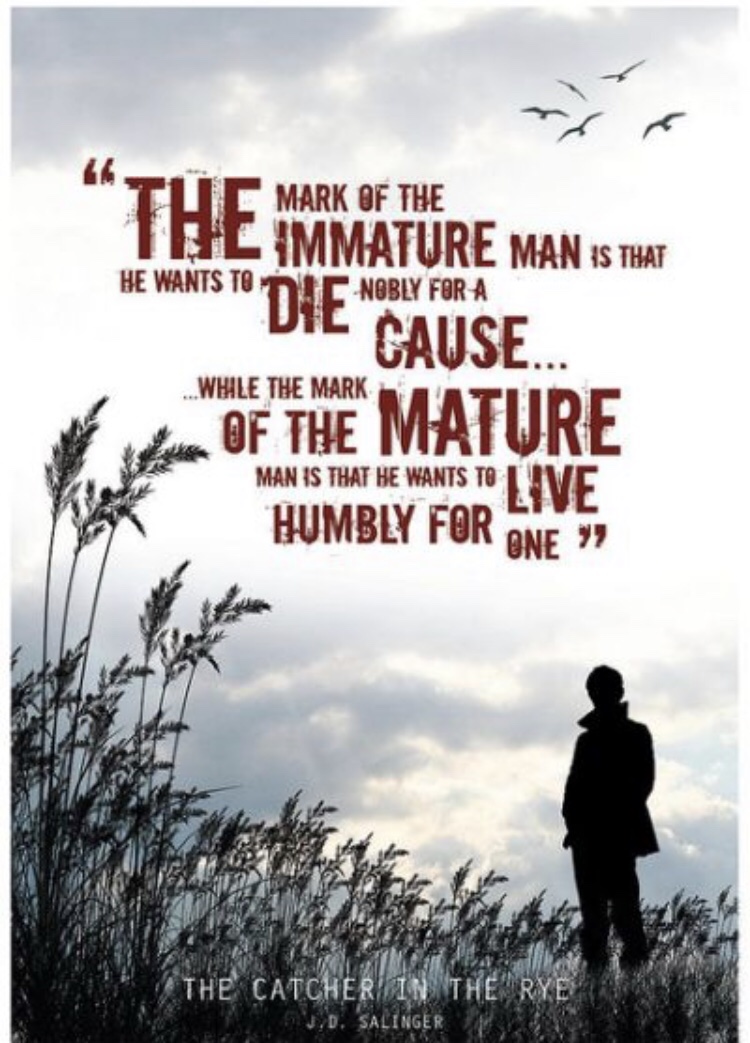
We all know Holden is in that coming of age stage, and in this chapter we see a few signs of both maturity and innocence in his character. For example, on page 31, Holden doesn’t understand exactly what’s going on when he’s approached about hiring a prostitute, showing some of Holden’s innocence; however, Holden loves to do “adult” things like smoke and drink, showing some levels of “maturity.” One thing we know for sure, though, is that Holden doesn’t want to grow up. He even wishes he could pull a Peter Pan and freeze time itself. He wants to live a fun, young life without any of the trials that come with being an adult. He even tries to share his youth with Sally, asking her to run away with him and shack up. Sally’s response was something along the lines of “Maybe after you go to college.” I don’t think she gets the point.

Remember how I talked about the whole “Life is a game” thing in a previous post? Well we haven’t seen much more talk about it quite yet, but we do see some symbols that feed into Holden’s view on the subject. One example is the fact that he doesn’t really care about his possessions much. He’s perfectly willing to dish out his money as long as he likes whoever he’s giving it to. In fact, he doesn’t even really keep track of it. Secondly, he’s very good at hiding from whoever he wants to. Unless we’re talking about poker face, there isn’t much hiding you can do in a game. Maybe it could even be the fact that he’s an admitted coward, and he knows he would never be able to win a game, so he’d rather believe that it doesn’t exist. I guess we’ll learn more about it later.
The two themes that grow the most in this section are sexuality and religion, which kind of go hand-in-hand. Holden admits he’s a virgin, and he makes up lies to get out of having sex when he gets the chance. This shows us that Holden is practicing abstinence, but he probably wouldn’t admit to that. I guess he can’t make anymore excuses about how when he finally gets the chance, whoever he’s with changes their mind. It is obvious, though, how Holden is kind of in-between innocence and maturity when it comes to his sexuality, along with his treatment of girls. I guess it just depends on what kind of mood he’s in. On the aspect of religion, I think Holden is very unsure. He does say he’s “probably an atheist,” but he also talks about what he believes Jesus would and wouldn’t like. Also, he bonds really well with the nuns. He even gives them money for their service. I’m not really sure exactly how Holden really feels about religion at this point. I guess we’ll learn more about it later.
The final thing that Holden reveals in this chapter is a motif: the ducks. Holden clarifies that the ducks represent people in his life who have left him. He wonders where they go, but he does know that some of them will never come back (like Allie).
Well, that’s all I have for today. Stick around for more lit information. Talk to you later:)


